Image courtesy of the artist
Text by Editor in Chief / Curator / Irina RUSINOVICH
Yuange Sheng’s „Residue Habitat“ begins with objects that have already served another purpose. A car headlight, a water dispenser and fragments of urban infrastructure are lifted out of the systems for which they were designed and reassembled into dense sculptural bodies in which feathers gather around rigid surfaces and functional shells become enclosures. The source objects remain recognisable, but their previous use no longer determines what they are. Sheng’s interest lies less in converting discarded material into sculpture than in what becomes possible once function stops defining an object and it enters a different set of spatial and material relationships.
The series was developed during Sheng’s 2026 residency at Trinity Art Studios in London, a period in which concerns present throughout his practice were consolidated into a more explicitly sculptural language, bringing found industrial objects, organic material and questions of inhabitation into closer relation. Trained in architecture at Central Saint Martins, Sheng has worked consistently with grids, modules and architectural fragments, subjecting them to deformation, accumulation and reorganisation. Architecture depends on prediction and control: loads are anticipated, circulation is organised, materials are selected for their performance. Sheng treats those principles as provisional rather than absolute, allowing systems borrowed from the built environment to become porous and materially unruly.
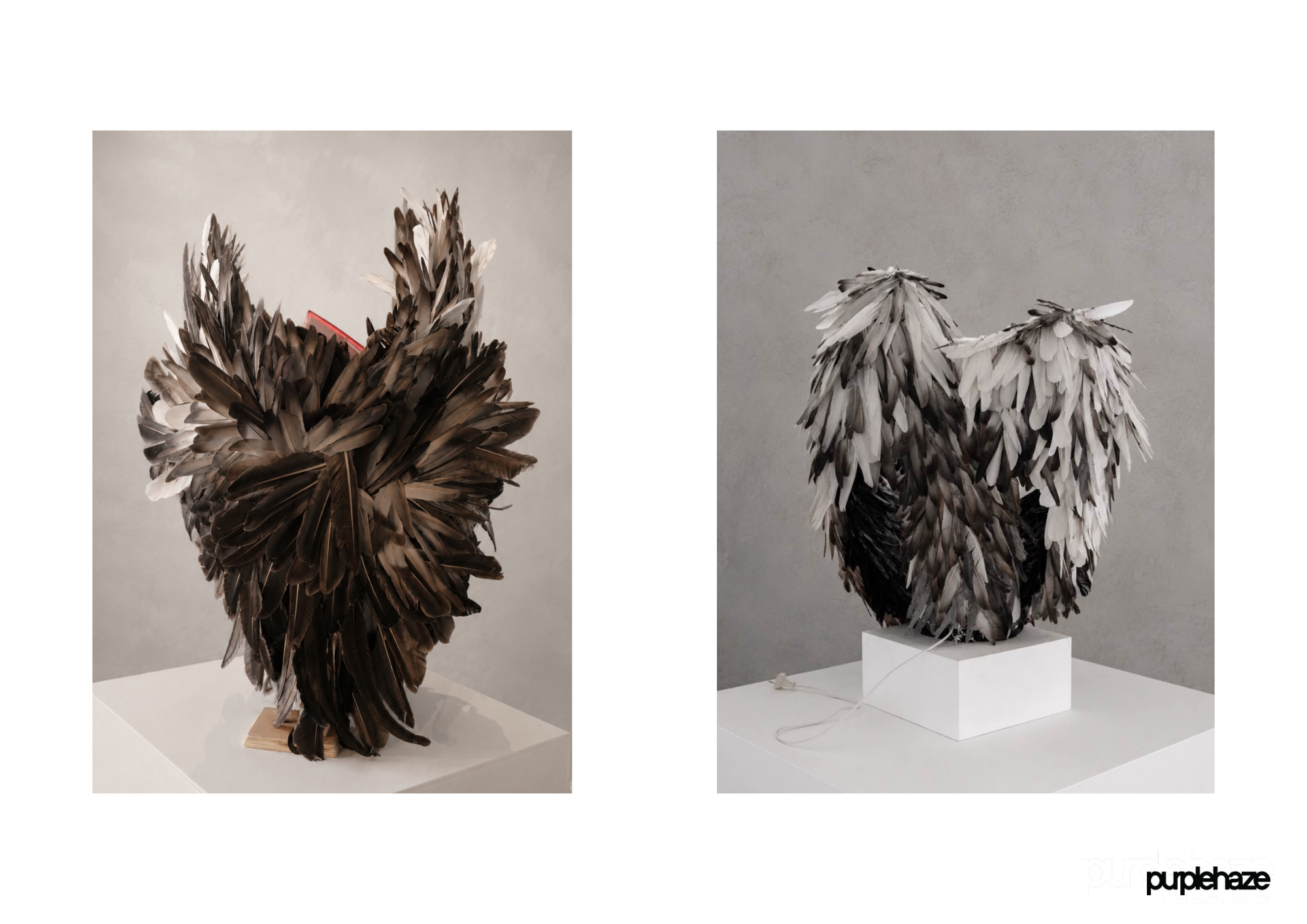
Image courtesy of the artist
In „Residue Habitat“ that provisionality is most visible in the meeting of industrial objects and feathers. Manufactured infrastructure carries rigidity, utility and standardisation; feathers carry insulation, growth and the animal body. Sheng compresses the two rather than resolving them, and neither category survives intact. Accumulated in quantity, the feathers stop reading as individual organic forms and begin to operate as surfaces, skins and improvised envelopes, their apparent softness complicated by the density that repetition produces.
In the sculpture built around a car headlight, the industrial component stays immediately legible, its red plastic cutting through the muted feathered mass with the artificial intensity of a signal. Detached from the vehicle, it can no longer perform the function that once defined it and persists instead as evidence of the technological system from which it was severed. The work incorporating a water dispenser carries out a related operation: an appliance designed to store, regulate and distribute a resource is surrounded by forms suggesting wings, tissue and protective covering, and the result settles into neither machine, body nor shelter.
Much of the strength of these works comes from Sheng’s refusal to use feathers as shorthand for nature reclaiming technology. That reading would restore a familiar opposition between industrial civilisation and an idealised organic world. The feathers are themselves displaced, accumulated and reorganised alongside plastic, metal, wiring and manufactured objects, and the line between natural and artificial becomes difficult to hold. What the sculptures propose instead is an environment in which biological and technological material have already grown inseparable.
Image courtesy of the artist
Read alongside recent materialist thought, and particularly Jane Bennett’s account of material agency, that proposition becomes sharper. In Vibrant Matter, Bennett disputes the assumption that agency belongs exclusively to human subjects, describing events as the product of shifting configurations of human and nonhuman forces. Sheng’s sculptures are not illustrations of that argument, but the comparison brings out something central to his method: matter is never entirely passive here. Industrial fragments carry prior functions, dimensions and histories into the work, while gravity, weight, density and surface impose their own limits and possibilities. The forms read less as the execution of a predetermined idea than as negotiated arrangements.
Tim Ingold’s writing on making offers a related frame, one in which form develops through engagement with active materials rather than through the imposition of design upon inert substance. Sheng works inside that tension between intention and material response. The sculptures are deliberately constructed and still resist the impression of complete mastery, since the systems he borrows to impose order are met by materials capable of redirecting it.
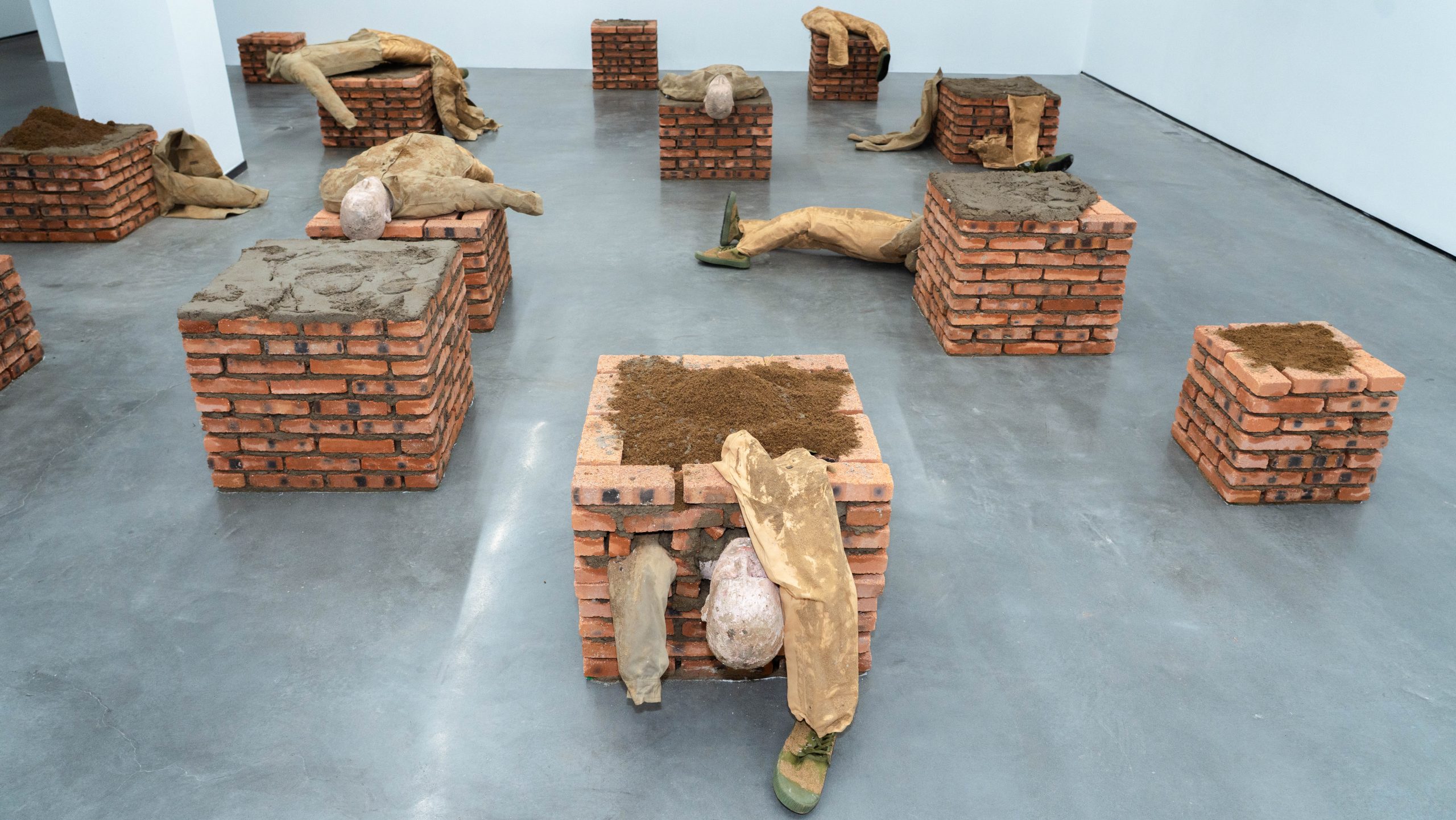
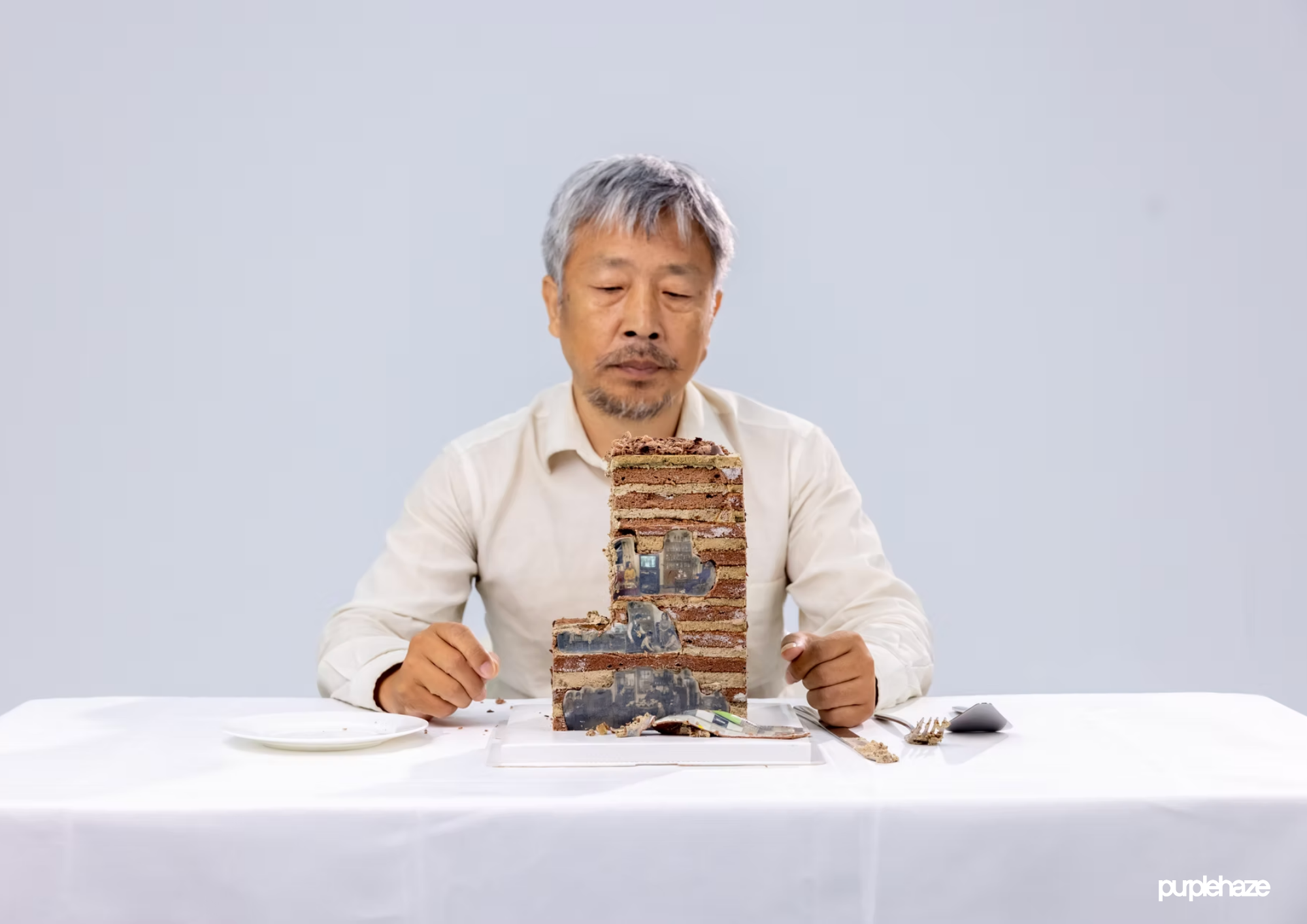
The concern predates „Residue Habitat“. In „Tetris Skyline“ (2023) Sheng reconfigures images of dense residential architecture, cutting geometric openings into facades and letting fragments of sky interrupt the urban fabric. The reference to the game is well chosen, since Tetris rewards spatial efficiency by eliminating gaps, and Sheng reverses that logic to make absence structurally dominant. Architecture stops functioning purely as enclosure and becomes a frame through which the external environment enters. What begins as a digital manipulation of urban form opens into a wider enquiry into spatial control, which Residue Habitat continues in physical terms by asking what might occupy a structure once its original organisation begins to fail.
Image courtesy of the artist
The word habitat therefore carries more weight than the animal associations of the works might suggest. A habitat is a network of conditions through which bodies, materials and environments coexist rather than a shelter alone. Paired with residue, it produces an ecology assembled from what has been used, displaced or exhausted. Residue sits low in any hierarchy of value, understood as what is left once the useful part has been extracted, and Sheng makes that remainder the condition from which new relationships develop.
Anna Lowenhaupt Tsing’s account of survival in damaged environments in The Mushroom at the End of the World is useful at this point. Tsing follows forms of life that emerge in landscapes already transformed by human intervention rather than in a state of imagined ecological purity. Sheng works at a different scale and without her political and economic framework, but Residue Habitat likewise declines to present renewal as a return to an untouched natural order. The industrial object is neither erased nor redeemed, and its history stays physically present within the new configuration.
This separates the series from environmentally engaged assemblage in which discarded material serves mainly as evidence of consumption and ecological damage. Reuse is central to how the works are built, yet they resist becoming moral statements about waste. Sheng’s attention goes to what discarded things can become once released from the systems that assigned their value, which accounts for the peculiar bodily presence of the sculptures: feathered masses swell, fold inward and gather around technological fragments that occasionally read as organs embedded in tissue, without ever arriving at anthropomorphic creatures.
That restraint matters. Sculptures convincingly animal-like would collapse into metaphor, while industrial components left too autonomous would settle into the established history of found-object assemblage. Sheng holds the works between those positions, at a point where object, body and environment become difficult to tell apart. The result is not a seamless hybrid but a category whose internal tensions stay visible.