
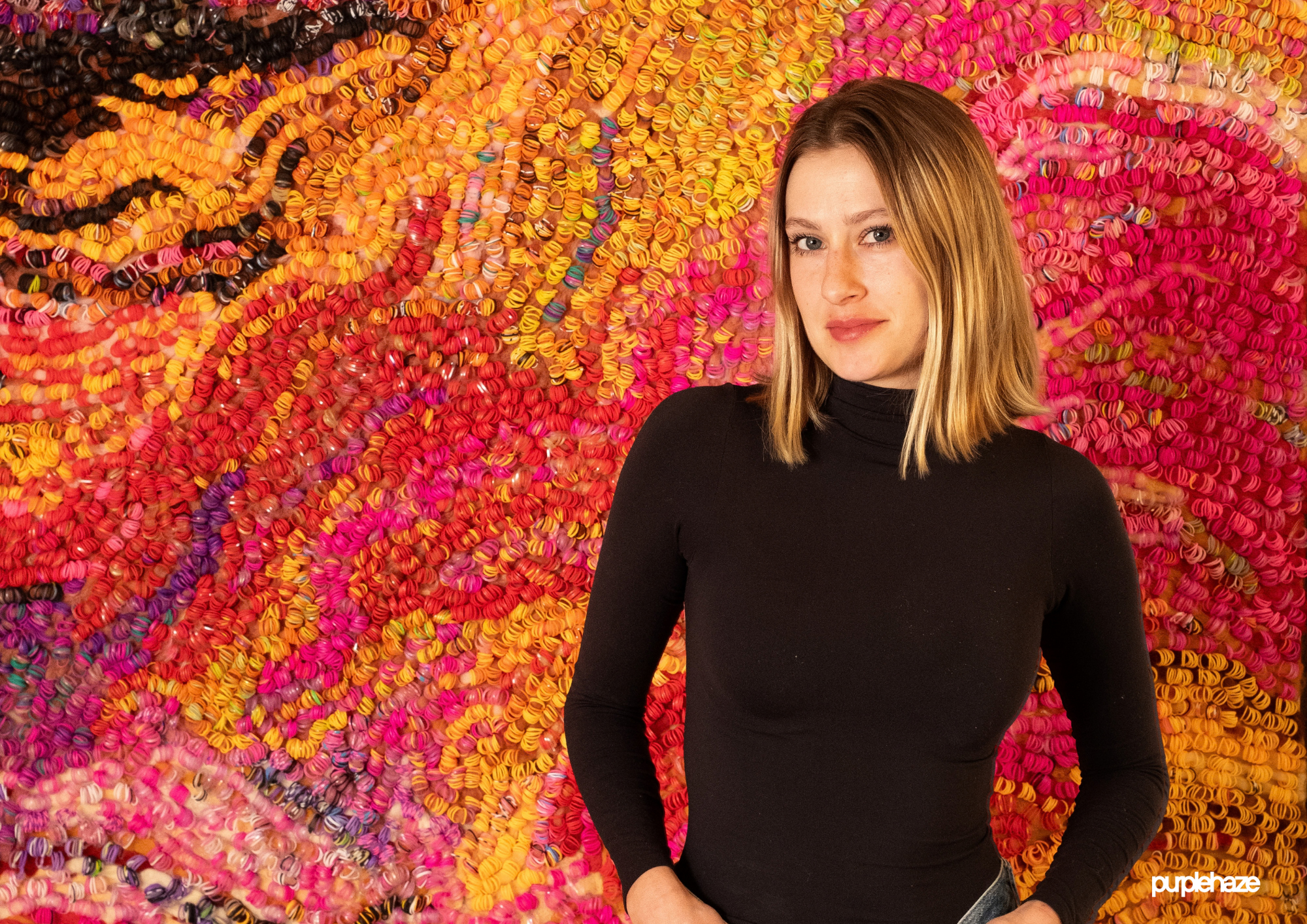
photo courtesy of the artist
Text by Irina RUSINOVICH
Hannah Buechler builds her recent works from an unlikely combination of loom bands, wool and felt, materials whose everyday associations begin to disappear as soon as they accumulate. At a distance, the surfaces suggest painting; closer inspection reveals a highly physical textile process made from hundreds of repeated gestures.
Buechler works across textile, painting and beadwork, and her current practice brings those disciplines into particularly close contact. Coloured loom bands are strung onto hundreds of wool strips, which she describes as “brush-strokes”, before being attached to felt through needle felting. The process is slow, tactile and repetitive, yet the finished works avoid feeling rigid or overly controlled. Instead, the surface develops through density, rhythm and gradual shifts in colour.
Seen from a distance, the pieces hold together as images. Colour gathers into areas of varying intensity, lines stretch across the surface, and forms begin to suggest landscapes, weather systems, anatomical structures or topographical maps. Buechler herself points to associations ranging from graphical weather forecasts and designer rugs to anatomical references and cartography.
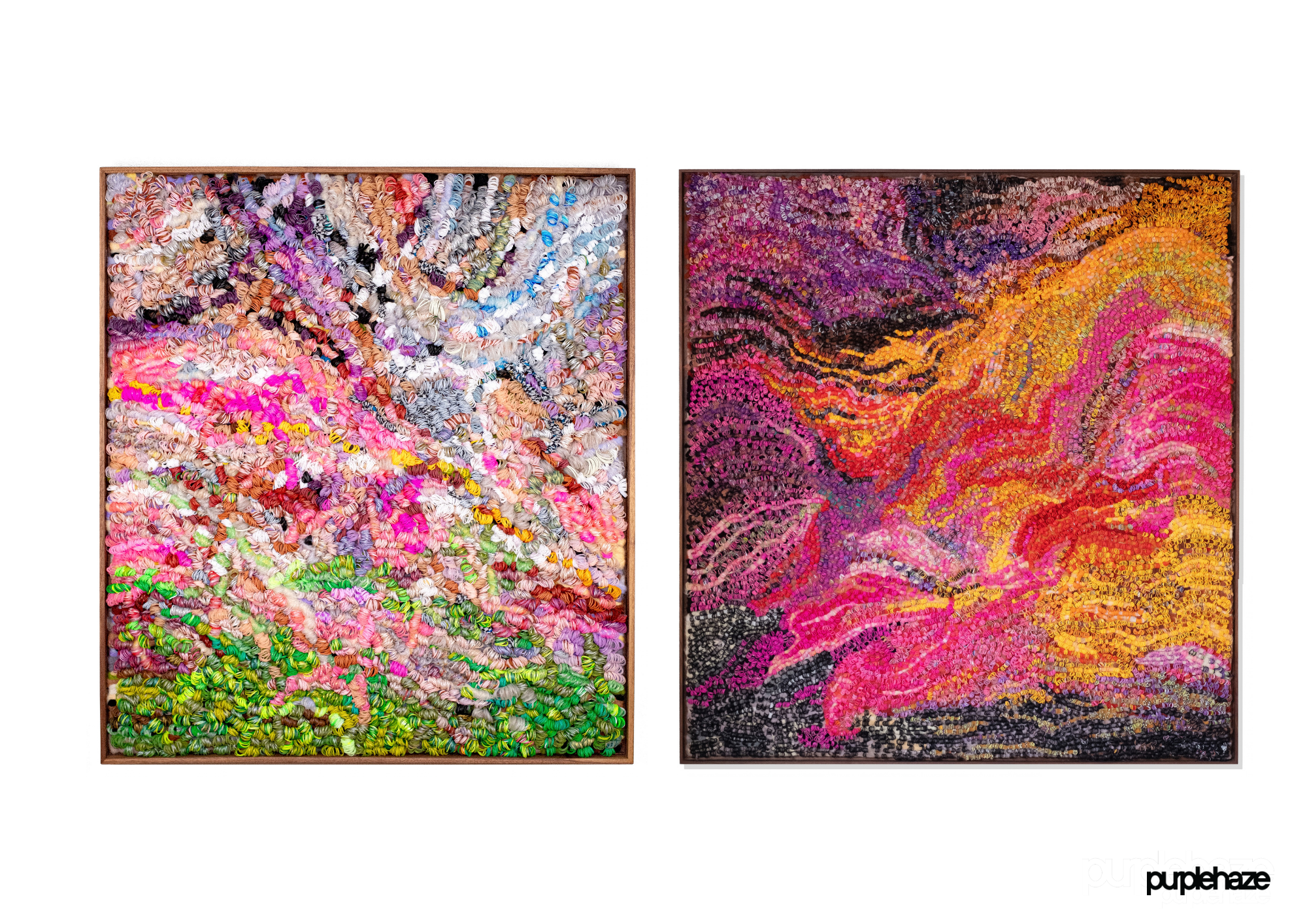
photo courtesy of the artist
Up close, that coherence starts to dissolve. The image breaks apart into loops, fibres and individual units, and the eye becomes aware of the labour embedded in the work. This movement between distance and proximity gives the pieces much of their visual tension. They can be read as abstract compositions, tactile objects or fields of repeated material, depending on how closely they are viewed.
Repetition is central to Buechler’s process, although it functions as more than a formal device. The physical time involved in making each piece creates space for decisions to develop gradually, allowing colour and composition to emerge through the act of making rather than from a fully predetermined plan. Her broader practice follows the same principle, using accumulation to turn relatively simple gestures into visually complex surfaces.
The materials themselves carry another layer of tension. Synthetic loom bands sit against wool and felt, bringing industrial and tactile qualities into the same object. Buechler has an ongoing interest in the origins and behaviour of materials, including recycled elements and objects connected to personal memory. This attention to material history keeps the work from becoming purely decorative, even when pattern and colour are highly seductive.
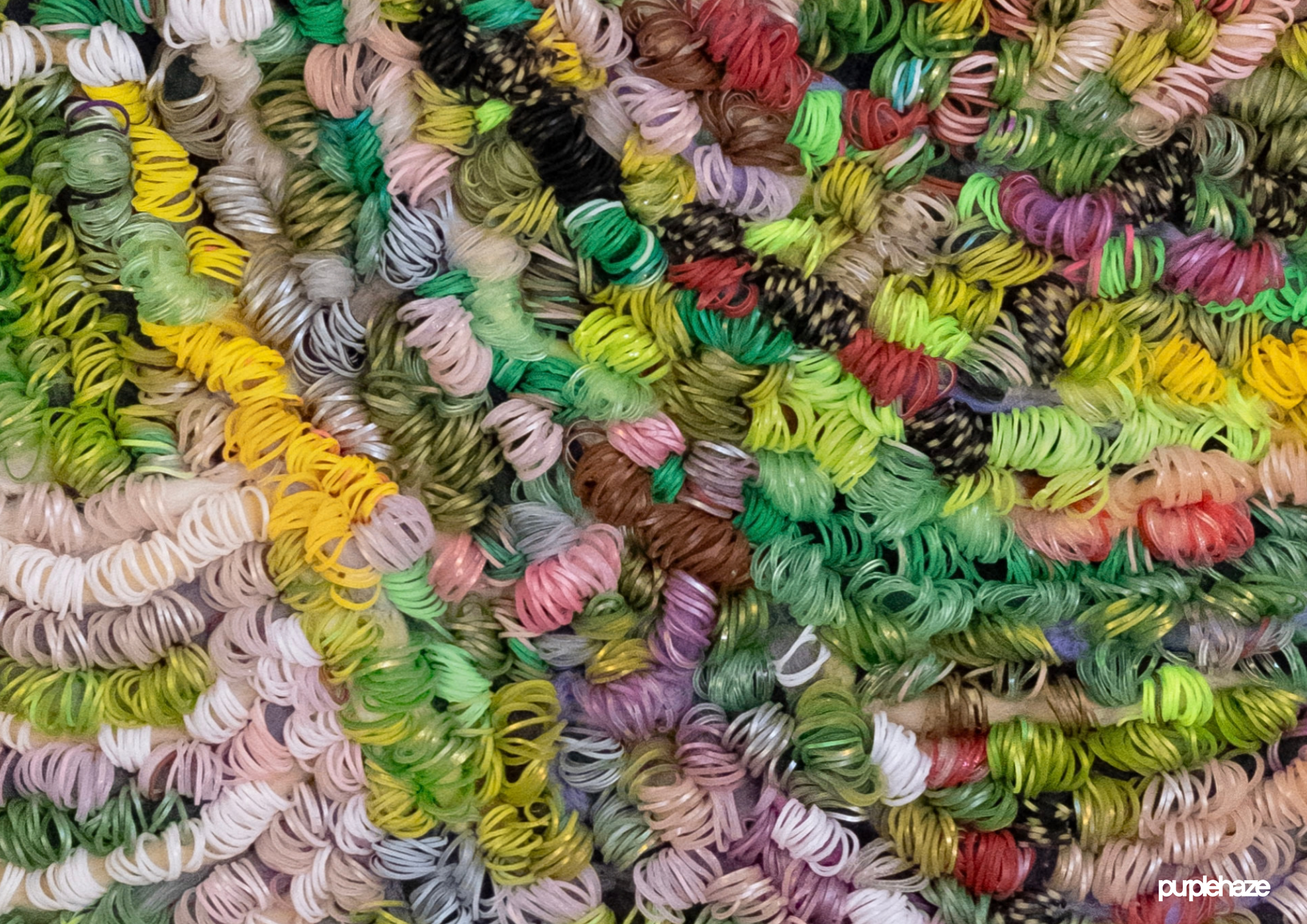
photo courtesy of the artist
In works such as Don’t Push and Sting, the surface becomes almost spatial. Lines gather, separate and reconnect, creating structures that feel organic without becoming illustrative. The works resist a single reading, and that ambiguity is important. They move between textile and painting, between object and image, and between the familiar scale of an everyday material and the larger visual field it eventually creates.
Buechler studied fibers at the Savannah College of Art and Design, where she also minored in painting. Her professional background includes textile and pattern design within fashion and interiors, and that experience is visible in her understanding of colour, structure and surface.
What makes the work convincing is the discipline behind the excess. The surfaces are rich, layered and visually dense, yet every effect comes from a limited set of materials and a repeated physical action. The result feels expansive without losing the intimacy of something made slowly by hand.
Buechler’s practice also sits within a broader shift in contemporary textile art, where the medium no longer needs to choose between craft, image and object. Her work moves freely across those categories while remaining grounded in the physical intelligence of making. In Don’t Push and Sting, textile is neither support nor ornament; it carries the image itself, together with the time, repetition and material decisions required to construct it.