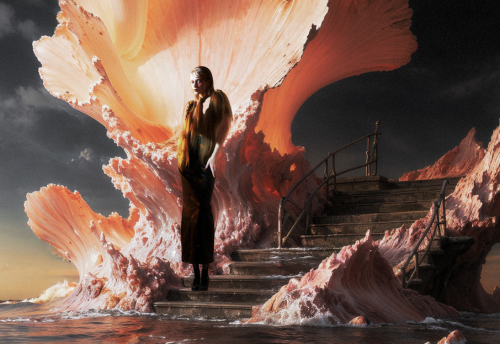
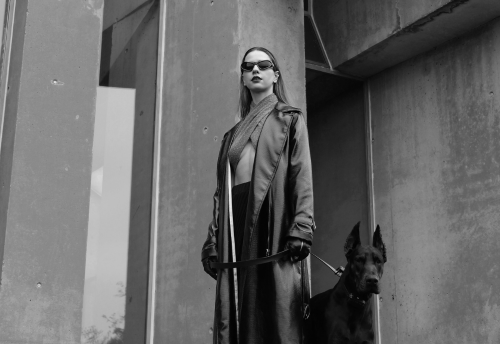
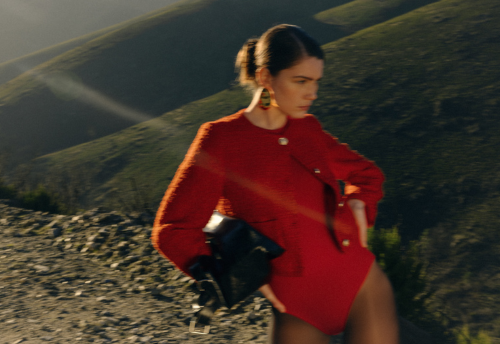
sirène
Fashion Designer & Stylist: Lion Busch @lion_busch
Hair and Make-up: Aurelia Braga de Matos @aurelia_braga_de_matos
Model: Haein Yoon @shtlux
Agency: @vivamodelsberlin
Shoes and Accessoires: stylist ́s own
sirène
Text: Lyubov Melnickowa
Thank you for taking time for an den interview with us! Before asking questions about the brand, I would like to learn more about the designer and founder of the brand KERIMA ELFAZA.
Tell a little about yourself. How did your creative path begin and why did you decide to become a fashion designer?
From an early age on, I was not only fascinated by fashion. I have loved drawing, colours, shapes, patterns and materials since I can remember. I knew I was about to build my life around this. If you take a look at my designs you can see that I love to experiment with different colours. In my working process I reconsider, reorder, and redraw everything many times until I have a feeling of satisfaction of what I came up with.
My brand is not only exclusively a fashion brand. Often my designs are exhibited in art galleries or shown in performances. I love to think of myself as an independent designer who works in different media.
What does fashion mean in your understanding?
It‘s a way to express myself. It‘s about identity. Growing up in a german/arabic family was not easy for me. My creative side got pushed down my whole childhood and I am still struggling sometimes with the feeling of not being enough or being too much. My desire to work with fashion and art always kept me in between these worlds. Fashion should not only be aesthetically appealing and innovative. In my opinion it should also serve as a medium of communication to discuss current and relevant topics in society. Fashion is intertwined with culture, origins, history and zeitgeist.
Tell us a little about the brand. At what point did the idea of creating a brand come up?
There was no ‚exact‘ moment or point where it all started. I have been starting to exhibit and present my work in galleries, shows and competitions like the „European Fashion Award“ (FASH) already, during my studies at art school. In that time, I started presenting my work on social media, got an invite to a variety of events like fashion shoots, shows, performances, exhibitions and pop-up stores. I have been very grateful for these opportunities, but it has been a lot of work to be recognized with my brand.
I started using 3D scans, 3D printing and digital prints on my fabrics in my BA. I developed more digital printed jewellery and concepts for digital print on textile while working on exhibitions.
As a rule, a clothing brand is a large team that takes part in the creation of collections. How many people are in the brand team and what are the responsibilities of the chief designer?
You could say I am a 1-Person army creating my collections. I work on the designs, create prototypes, handcraft and digitalize, as well as producing the clothing. I have a huge passion for manipulating textile surfaces and since I moved to Bremen I also started casting my own jewellery.
Of course it takes a whole team to realize ideas and projects. I usually work with a video producer, digital artists, make up artists, dancers & performers. Participating in an exhibition also requires communicating with curators to finalize the vision of my brand.
How would you describe the brand’s style?
My idea is that collections should not appear just pleasing and wearable, rather sending the message to provoke. I have more of an artistic perspective on fashion. Whether I press „garbage“ onto jeans or let crystals grow on fabric, behind every artistic exploration in material, there is always a hidden social critical message. Personalized clothing as a specific and interdisciplinary art form and jewellery opens up the opportunity to celebrate everybody’s uniqueness.
Now many brands are for environmental friendliness and recycling. What materials does the KERIMA ELFAZA brand use? What principles do you adhere to when creating clothes?
I love digital printing, especially on silk, using foil and 3D prints. For the future I will no longer require digital prints produced in metered fabrics. I want to use screen printing and use bacteria that can grow the colours. Working with the Clo3D (a digital fashion programm) will increase sustainability by reducing the production of prototypes and it also allows an open discussion with customers online.
My 3D prints are made exclusively out of recycled polyamide. I am trying to develop more sustainable ways to produce 3D printed garments and accessories. Also I like the combination of the technology of 3D printing and traditional craftingship with aluminium and bronze.
Who is the KERIMA ELFAZA brand for? Can you describe its target audience?
It‘s not directly specifically designed for a certain stereotype or cliche that many big brands work with. My brand shows the diversity of people, no matter their size, age, ethnic background or gender identity.
My latest collection, „SECOND_SCAN“ has a very personal reference for standing up for yourself, making your own change, no matter who you are or that you’re not fitting into any categories.
KERIMA ELFAZA is a well-known brand in Bremen, Germany. Would you like the brand to exist on the world market in the future?
It‘s a big goal and a dream of mine to present my brand internationally. As an artist I am already present at several events, for example I will be participating at a fashion festival in the Netherlands this year.
I am always researching new techniques to push my brand and level up.
How would you describe today’s fashion and what feelings does evoke in you?
I see the same problems in fashion, as well as in the food industry. Who consumes should take responsibility. The consumer’s awareness is increasing, but at the same time the textile waste is also piling up. The issues of the broader concept of diversity, gender equality, animal welfare and sustainability must continuously evolve. We are not at the end of our rope yet. Innovative ideas of young designers who are deeply concerned about the production chain of materials need to be further explored and developed. I am trying to deal with these issues in my work process.
My first collection „Is(s) mir Wurst“, like „eat sausage“ which means „I don‘t care“, and my second collection „Kopyright“ have been both clever, ironic, ambivalent puns to openly criticize mass consumption. The protection of intellectual property constitutes an imperative in the age of Instagram and TikTok, in order to be able to preserve artistic design in the fashion industry. „Kopyright“ combines an explicit cross reference to „fast fashion“, by challenging plagiarism of discount clothing stores. While „Is(s) mir Wurst“, denounces societies opulent and careless consumption of meat. As source of my inspiration served a native east german provincial butcher, whose meat products I literally scanned and subsequently printo onto the fabrics.
ORGANIC
Photography & art direction: CHRISTINA KAPONGO @christinakapongo
Makeup & Hair: ESTRELLA ELORDUY @estrellaelorduy
Model: KADEEM SAMUELl @de3m_
Model Agency: BENTŌ
MUSSA canaria Extra moisturising vegan body cream with natural coconut oil and coconut butter H&M hat; vegano hero all-purpuse lip Cream
Lotus Radiance Dark Spot Treatment help to reduce impurities in your face GEMA GALDON HAT GALERRY. CALVIN KLEIN’S UNDERWEAR Jeans DSQUERED2
Eternal Ink tintes veganos 100% y cruelty free Ink colors tatoo;
DR.Andrew Weil for Origins Mega – mushroom relief & resilience soothing cream SOMBRERERIA MIL hat
Old neck of cloth from KAPO’S privacy Collection. Carton shoes horme
Between Dreams
Accessory Designer: Dopl World @dopl.world
Model: Tyson Elizabeth Pope @misfit model management @tysonelizabethhh
Photographer: Noa Lesche @skytwylite
Look 1 Bella Top; Marionette Necklace; Marquis Skirt; Look 2 Magdalene Necklace; Muse Corset; The shorts were off Amazon
Text: Lyubov Melnickowa
As a rule, a clothing brand is a large team that takes part in the creation of collections. How many people are in the brand team and what are the responsibilities of the chief designer?
Like most independent designers I started on my own. It’s working around the clock to do research, design, pattern cutting, sewing prototypes, creating marketing materials, doing production, some PR, accounting and much more. With limited resources it’s a difficult process but seeing even the slightest success is very rewarding.
I was quite fortunate to have my partner Markus and my mother on my side for moral and professional support.
How would you describe the brand’s style?
A close friend of mine used to say I do a kind of “complex minimalism”. Certainly I like to experiment with shape, volume and texture to create new and exciting garments. Although I feel close in my ethos to the Japanese and Belgian Avantgarde, I don’t like to use this term since it’s become rather constricting aesthetically.
Now many brands are for environmental friendliness and recycling. What materials does the des FILLES désir brand use? What principles do you adhere to when creating clothes?
Preferably I work with high quality yet overlooked fabrics that allow me to create sculptural garments. I also consider how fabrics might feel on the skin or how durable they are. They’re mostly from Italian manufacturers or small and specialized stores. Being a small label and working mostly made-to-order, I think the environmental impact in our case is minimal. While I consider this debate to be important, it also allows for a lot of greenwashing. As the demand for fair and ecologically produced garments grows, it will become increasingly easy to integrate these in future garments.
The design process starts with an abstract theme or some kind of observation that I try to translate into techniques or shapes before moving on to make the actual garment. I like to challenge myself to find new ways to create garments that you wouldn‘t find anywhere else.
Who is the des FILLES désir brand for? Can you describe its target audience?
I would like to see anyone trying on des FILLES désir and integrating the pieces in their daily lives. However the designs mostly attract creative people who like to experiment with new things and who are not afraid to be noticed for their bold choices.
des FILLES désir is a well-known brand in Berlin. Would you like the brand to exist on the world market in the future?
There’s still quite some work to be done to reach more people. But I’m confident that this can only be achieved by a slow and steady growth.
How would you describe today’s fashion and what feelings does it evoke in you?
Fashion as a broader phenomenon in the West has lost its luster in the last two decades. At least when we compare its current state to its rich history one might come to the conclusion that fashion has lost its meaning.
However there are still bubbles of interested people gravitating certain styles and designers that aren’t happy with today’s conformity. For me it’s still uplifting to see groundbreaking designs from fresh labels that have to fight to get heard and also to see people who have a strong personal style and who care about expressing themselves.
American football with MARK BRYAN
Text by Lucas Pantoja
Neueste Kommentare